Buy greatpoland.eu ?
We are moving the project
greatpoland.eu .
Are you interested in purchasing the domain
greatpoland.eu ?
domain@kv-gmbh.de · 0541-91531010
Buy greatpoland.eu ?
What is the history of the conquest of the Inca Empire?
The conquest of the Inca Empire began in 1532 when the Spanish conquistador Francisco Pizarro and his men arrived in the Inca territory, seeking to conquer and colonize the region. Pizarro took advantage of the internal divisions within the Inca Empire and formed alliances with local indigenous groups who were unhappy with Inca rule. This allowed the Spanish to defeat the Inca forces and capture their leader, Atahualpa, in the Battle of Cajamarca. Despite paying a ransom, Atahualpa was eventually executed by the Spanish, leading to further conflict and the eventual fall of the Inca Empire. The conquest of the Inca Empire marked the beginning of Spanish colonization in South America and the end of the Inca civilization. **
Why was the Aztec Empire a high culture?
The Aztec Empire was considered a high culture because of its advanced social, political, and religious organization. The Aztecs had a complex social structure with a well-defined class system, a sophisticated system of governance, and a highly developed religious belief system. They also had impressive architectural and engineering achievements, such as the construction of the city of Tenochtitlan on a series of artificial islands in Lake Texcoco. Additionally, the Aztecs made significant advancements in agriculture, art, and writing, demonstrating a high level of cultural and intellectual achievement. **

Similar search terms for Empire-Of-Pain-The
Top-Angebote
Products related to Empire-Of-Pain-The:
-
Various Vladimir Putin Rob Sears, Empire of Pain, Kleptopia Collection 3 Books SetDescription:. Condition: BRAND NEW. Format: Mixed lot. Vladimir Putin: Life Coach. What can the rise of this century's most feared politician teach us. about life, work and love? Rob Sears satirises the machinations that. enabled Putin to dominate the Kremlin and undermine the United States. of America as ways to help you take control of your mundane life.. Would you like to ruin your enemies by sharing compromising material. about that time they didn't wash their hands? Fancy hacking democracy. at the parent-teacher association to ensure you're a shoo-in for. social secretary? Or serving up a cold dish called revenge in a high. street restaurant..... Empire of Pain: The Secret History of the Sackler. The Sackler name adorns the walls of many storied institutions –. Harvard; the Metropolitan Museum of Art; Oxford; the Louvre. They are. one of the richest families in the world, known for their lavish. donations in the arts and the sciences. The source of the family. fortune was vague, however, until it emerged that the Sacklers were. responsible for making and marketing Oxycontin, a blockbuster. painkiller that was a catalyst for the opioid crisis – an. international epidemic of drug addiction which has killed nearly half. a million people...... KLEPTOPIA: How Dirty Money is Conquering the World...... Kleptopia follows the dirty money that is flooding the global economy,. emboldening dictators, enriching oligarchs and poisoning democracies.. From the Kremlin to Beijing, Harare to Riyadh, London to the Trump. White House, it shows how the thieves are uniting – and the terrible. human cost.A body in a burned-out Audi. Workers riddled with bullets. in the Kazakh desert. A rigged election in Zimbabwe. A British banker. silenced and humiliated for trying to expose the truth about the City. of London – the world’s piggy bank for blood money.. Title. Vladimir Putin Rob Sears, Empire of Pain, Kleptopia Collection 3 Books Set. Delivery. Content. Reviews99,99 £*Shipping: 0,00 £Secure redirect to the provider
-
Patrick Radden Keefe 4 Books Collection Set (Rogues, The Snakehead, Empire of Pain, Say Nothing)- Non Fiction - PaperbackTitles in This Set:. Rogues. The Snakehead. Empire Of Pain. Say Nothing. Condition:BRAND NEW. Format:Paperback. ISBN:9780678471326. Overview:. This is a premium four‑book paperback collection by Patrick Radden Keefe, bringing together four of his most acclaimed, provocative works in one value‑driven set. Rogues gathers Keefe’s sharp, meticulously reported longform essays from The New Yorker, exploring the uneasy relationship between power, crime, and ordinary people who are drawn into extraordinary, often dangerous schemes. The Snakehead dives into the shadowy world of international human smuggling, delivering a gripping, character‑driven narrative that reads like a real‑world thriller while remaining rigorously factual. Empire Of Pain invites you into the intricate, morally complex saga of the Sackler family and the opioid crisis, blending investigative depth with a sweeping historical panorama. Say Nothing unpacks the Troubles in Northern Ireland with suspenseful precision, reassembling memory, motive, and consequence into a riveting biography of a society at war with itself. In this single paperback collection, Keefe’s voice—clear, humane, relentlessly curious—anchors four distinct threads into a cohesive reading experience that rewards patient readers with insight, nuance, and towering storytelling.. What Makes This Collection Special:. What ties Rogues, The Snakehead, Empire Of Pain, and Say Nothing together is Patrick Radden Keefe’s signature approach: patient inquiry, fearless curiosity, and the ability to turn sprawling subjects into intimate, riveting narratives. Across these titles, readers encounter a unifying tapestry of power, betrayal, resilience, and consequence. The collection offers a rare reading journey through crime, business, history, and politics—each book a masterclass in investigative journalism that doesn’t merely present facts but reveals the human stories behind them. It’s the kind of set that invites re‑reading, sparks discussion in book clubs, and suits curious minds who want a bookshelf of non‑fiction that reads like the best‑paced thrillers. For gifting, this quartet delivers breadth and depth in one elegant package—a complete Keefe experience for fans of true crime, social history, and rigorous journalism.. Books Included in This Collection:. Rogues. Rogues collects Keefe’s most gripping New Yorker investigations into power, crime, and moral ambiguity. The essays profile individuals who invert fortune, charismatically manipulating systems or bending the truth. The result is a vivid, thought‑provoking gallery of people who demonstrate how easily desire, loyalty, and fear can collide with law and ethics. With Keefe’s crisp prose and careful reconstruction of complex cases, Rogues invites readers to question the grey zones that populate headlines and to consider what truth looks like when witnessed from a reporter’s steady, skeptical gaze.. The Snakehead. The Snakehead offers an immersive, narrative‑driven examination...35,99 £*Shipping: 0,00 £Secure redirect to the provider
-
Anchor The Fall of the Roman Empire: A New History - Non FictionTitle:. The Fall of the Roman Empire: A New History Overview:. Peter Heather’s groundbreaking work dismantles centuries of historical myth surrounding the collapse of ancient Rome. Rather than accepting the long-standing narrative that internal corruption and socioeconomic decay doomed the Western Empire, Heather presents a rigorous, evidence-based analysis focusing on external pressures and geopolitical shifts between 395 and 476 AD. Drawing on archaeological discoveries, epigraphic records, and military logistics research, the book reconstructs a period once misunderstood as a chaotic decline into darkness. Instead, it portrays a tragic yet logical clash between a sophisticated administrative state and rapidly evolving migratory confederations pushed westward by larger forces beyond Europe’s borders. This thoroughly revised study offers readers a clear, chronologically structured account of how political fragmentation, diplomatic miscalculations, and sustained military encounters ultimately redrew the map of Eurasia. By grounding every claim in verifiable primary sources and contemporary scholarship, Heather delivers a compelling historical investigation that refreshes our understanding of one of antiquity’s most pivotal transformations. What Makes This Book Stand Out:. What distinguishes this volume in modern historical literature is its methodological precision and unflinching reliance on material evidence over inherited legend. While earlier accounts often framed the era’s downfall through dramatic moralising or sweeping civilisational pessimism, Heather treats the subject with analytical clarity, examining troop movements, border fortifications, treaty negotiations, and economic supply chains as interconnected variables. The author avoids romanticising either Rome or its adversaries, choosing instead to present complex historical actors making pragmatic decisions under extreme strain. Readers benefit from carefully crafted maps, concise chronological breakdowns, and accessible explanations of Latin terminology and Roman administrative structures. The prose remains engaging without sacrificing academic rigour, making intricate late antique geography and demographic shifts straightforward to navigate. This balanced approach transforms what could easily become a dense chronicle into a vivid exploration of institutional resilience, adaptive warfare, and the fragile nature of imperial longevity. Who This Book Is Perfect For:. This volume serves as an ideal companion for dedicated history enthusiasts seeking a well-researched alternative to popular narratives about Rome’s final centuries. University students studying classical antiquity or late medieval transitions will appreciate its structured methodology and reliable reference material, while casual readers looking to understand European civilisational foundations will find the pacing clear and highly rewarding. Professional instructors teaching ancient history also frequently adopt this text...49,90 £*Shipping: 0,00 £Secure redirect to the provider
-
Edge of the Empire Adventure Book - Star Wars: of the Empire - RPGTake your Star Wars: Edge of the Empire roleplaying campaign beyond the familiar trade routes and into the dangerous reaches of Wild Space. Beyond the Rim is a full-length adventure campaign designed for characters seeking fortune, recognition, and a way to settle old debts. The adventure unfolds across three acts, beginning at the Wheel, a busy space station at the center of competing interests. From there, the player characters travel to a remote jungle world, facing hostile environments, Imperial interference, rival explorers, and dangerous new adversaries. Key Features: - Full-length adventure for Star Wars: Edge of the Empire - Three-act campaign structure - Exploration across a space station and distant worlds - Encounters with Imperials, rival parties, and new enemies - Secrets connected to the Clone Wars This is a physical roleplaying adventure book for use with the Star Wars: Edge of the Empire game system.32,49 £*Shipping: 3,95 £Secure redirect to the provider


-
Is the Ottoman Empire the successor state of the Roman Empire?
The Ottoman Empire is not considered the direct successor state of the Roman Empire. While the Ottomans did conquer the city of Constantinople, the capital of the Eastern Roman Empire, in 1453, they were a separate and distinct entity from the Roman Empire. The Ottoman Empire was a Muslim state with its own unique culture, traditions, and governance structure, whereas the Roman Empire was a Christian state with a different set of values and institutions. **
-
Can someone summarize the history of the German Empire for me?
The German Empire, also known as the Second Reich, was established in 1871 after the unification of various German states under the leadership of Prussia. The empire was ruled by Kaiser Wilhelm I and later by his grandson Kaiser Wilhelm II. It was a major European power and played a significant role in global politics and conflicts, including World War I. The empire came to an end in 1918 with the abdication of Kaiser Wilhelm II and the establishment of the Weimar Republic. **
-
Which empire is better: the Ottoman Empire or the Byzantine Empire?
It is difficult to determine which empire is better as both the Ottoman and Byzantine Empires had their own unique strengths and weaknesses. The Byzantine Empire was known for its rich cultural and intellectual heritage, while the Ottoman Empire was known for its military prowess and expansive territorial control. The Byzantine Empire had a long and influential history, while the Ottoman Empire had a significant impact on the development of the Islamic world. Ultimately, the "better" empire depends on the criteria used to evaluate them, and both empires made important contributions to world history. **
-
Which empire was larger, the Alexander Empire or the Roman Empire?
The Roman Empire was larger than the Alexander Empire. At its peak, the Roman Empire covered approximately 5 million square kilometers, while the Alexander Empire, also known as the Macedonian Empire, covered around 2.2 million square kilometers. The Roman Empire's vast territory included parts of Europe, Africa, and Asia, making it one of the largest empires in history. **


What did the people think about the history of the founding of the empire?
The people believed that the history of the founding of the empire was a glorious and heroic tale. They saw the founding as a moment of triumph and unity, where their ancestors came together to build a powerful and prosperous empire. The founding story was often celebrated and commemorated through festivals, monuments, and storytelling, reinforcing the belief that their empire was destined for greatness. Overall, the people held the history of the founding of the empire in high regard, viewing it as a source of pride and inspiration. **
Which nations were part of the Roman Empire and the Byzantine Empire?
The Roman Empire included territories such as Italy, Spain, France, Greece, Egypt, and parts of the Middle East. The Byzantine Empire, also known as the Eastern Roman Empire, consisted of regions like Greece, Turkey, Syria, and Egypt. Over time, the Byzantine Empire expanded to include parts of the Balkans, North Africa, and the Caucasus region. **
Top-Angebote
Products related to Empire-Of-Pain-The:
-
Empire Of Pain: The Secret History Of The Sackler Dynasty by Patrick Radden Keefe - Non Fiction - PaperbackTitle:. Empire of Pain: Secret History of the Sackler Dynasty Condition: BRAND NEW. Format: Paperback Overview:. Empire of Pain: Secret History of the Sackler Dynasty is Patrick Radden Keefe’s meticulously reported portrait of a family whose philanthropy and power have shaped museums, universities, and cultural institutions around the world. Keefe, renowned for his immersive investigative work, threads archival records, court filings, and extensive interviews to trace how the Sacklers built a global empire around Purdue Pharma and OxyContin, and how that influence permeated public life. The narrative opens with the family’s ascent and their donations to renowned institutions—Harvard, the Metropolitan Museum of Art, Oxford, and the Louvre—then pulls back the curtain on the strategic thinking, secrecy, and public relations that kept their name in elite circles even as concerns about responsibility grew louder. The book scrutinizes regulatory battles, internal memos, and the human impact of the opioid crisis, offering a nuanced, morally complex account rather than a one‑sided indictment. The result is a gripping, deeply researched study of wealth, power, medicine, and accountability in the modern world, challenging readers to confront difficult questions about donor influence and public trust. Keefe’s thoughtful pace and evidentiary rigor make this a definitive, provocative history. What Makes This Book Stand Out:. Keefe’s Empire of Pain stands out for its relentless sourcing and narrative precision. It rests on thousands of pages of internal Purdue Pharma documents, contemporaneous records, depositions, and a broad network of interviews spanning decades. The result is not only a chronological account but a thoughtful map of how philanthropic capital can shape institutional priorities, scholarly discourse, and public memory. Keefe refuses easy blame, presenting the complexity of a dynasty built on ambition, family loyalty, and strategic philanthropy, while never shrinking from the human cost of the opioid crisis. The prose reads with the momentum of a suspenseful chapter‑spy novel, yet it remains scrupulously anchored in fact, making it both a compelling read and a trustworthy reference for debates about business ethics, public health, and cultural patronage. Who This Book Is Perfect For:. This book is ideal for readers who crave rigorous investigative history and context around a defining modern crisis. It will appeal to true‑crime and corporate‑history fans, students of healthcare policy and ethics, and anyone curious about how wealth, influence, and philanthropy intersect with public institutions. Suitable for book clubs and classroom discussions, it also serves as a comprehensive resource for researchers and general readers seeking a clear, nuanced portrait of a dynastic empire and its consequences. Key Highlights:. Authoritative investigative journalism from Patrick Radden Keefe. Extensive use of internal Purdue Pharma documents and court...9,99 £*Shipping: 2,99 £Secure redirect to the provider
-
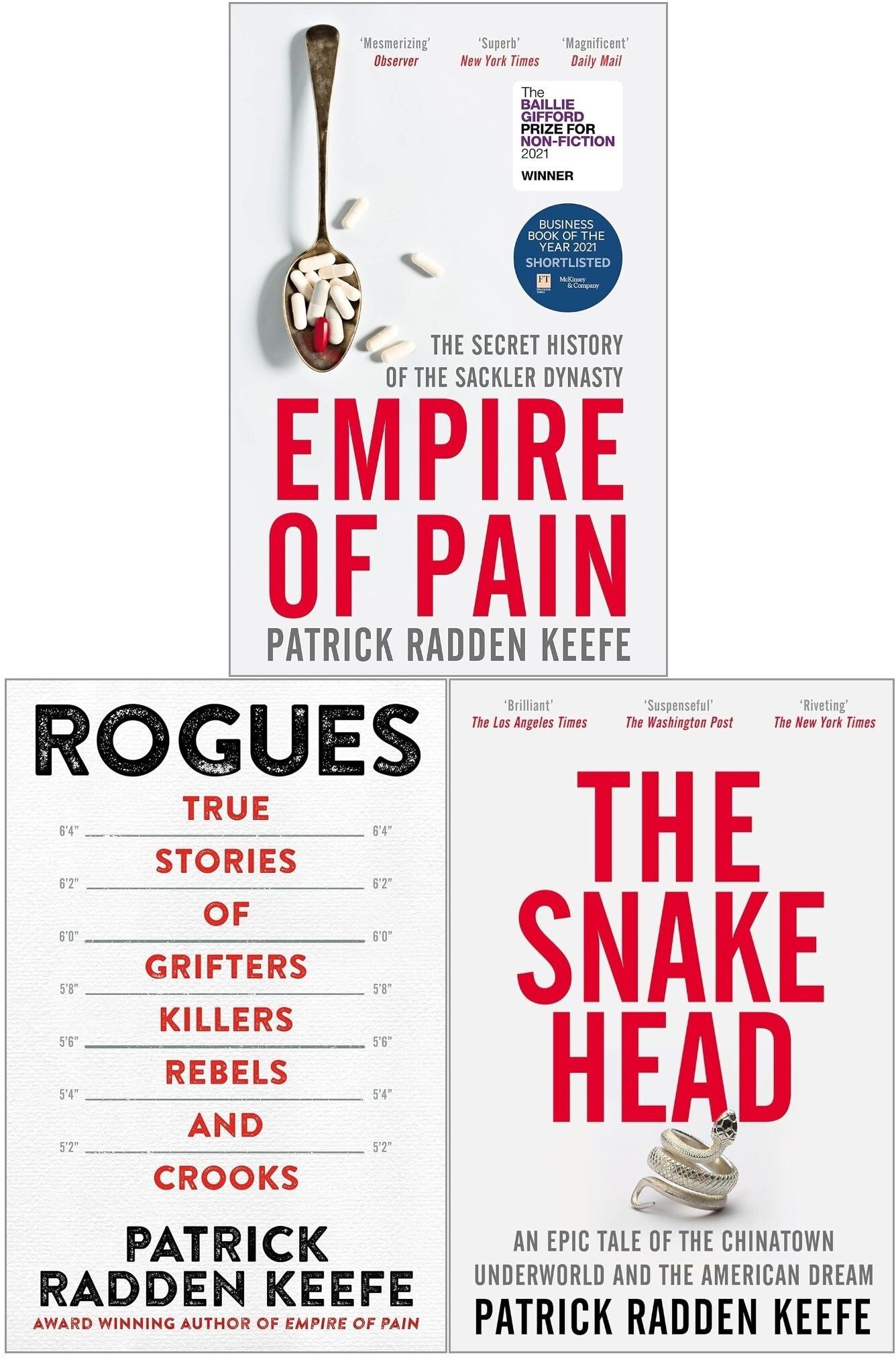
Picador Patrick Radden Keefe 3 Books Collection Set (Rogues, The Snakehead, Empire of Pain)Patrick Radden Keefe 3 Books Collection Set (Rogues, The Snakehead, Empire of Pain) Explore power, crime, corruption, and truth with the Patrick Radden Keefe 3 Books Collection Set, featuring Rogues, The Snakehead, and Empire of Pain. Written by acclaimed investigative journalist and New Yorker staff writer Patrick Radden Keefe, this essential nonfiction collection uncovers some of the most compelling and disturbing real-life stories of our time. From global crime networks and political corruption to the devastating opioid crisis, these books combine deep investigative reporting with gripping narrative storytelling. Perfect for readers of true crime, investigative journalism, history, and social justice, this collection offers a powerful examination of how influence, greed, and secrecy shape the modern world. Rogues: True Stories of Grifters, Killers, Rebels and Crooks Patrick Radden Keefe’s work has been recognized by prizes including the Orwell Prize and the Baillie Gifford for his meticulously reported and engaging work on the many ways people behave badly. Rogues brings together a dozen of his most celebrated articles from the New Yorker. As Keefe observes in his preface: ‘They reflect on some of my abiding preoccupations: crime and corruption, secrets and lies'. Keefe explores the intricacies of forging $150,000 vintage wines; examines whether a whistleblower who dared to expose money laundering at a Swiss bank is a hero or a liar; spends time in Vietnam with Anthony Bourdain; chronicles the quest to bring down a cheerful international black-market arms merchant; and profiles a passionate death-penalty attorney who represents the ‘worst of the worst’, among other works of literary journalism. The Snakehead: An Epic Tale of the Chinatown Underworld and the American Dream In this thrilling story of real-life events, the bestselling author of Empire of Pain investigates a secret world run by a surprising criminal: a charismatic middle-aged grandmother, who from a tiny noodle shop in New York’s Chinatown, managed a multimillion-dollar business smuggling people. In The Snakehead, Patrick Radden Keefe reveals the inner workings of Cheng Chui Ping aka Sister Ping’s complex empire and recounts the decade-long FBI investigation that eventually brought her down. He follows an often incompetent and sometimes corrupt INS as it pursues desperate immigrants risking everything to come to America, and along the way he paints a stunning portrait of a generation of undocumented immigrants and the intricate underground economy that sustains and exploits them. Empire of Pain: The Secret History of the Sackler Dynasty The Sackler name adorns the walls of many storied institutions like Harvard and the Metropolitan Museum of Art. They are one of the richest families in the world, known for their lavish donations in the arts and the sciences. The source of the family fortune was vague, however, until it emerged that the Sacklers were responsible for making and...24,99 £*Shipping: 2,99 £Secure redirect to the provider
-
Various Vladimir Putin Rob Sears, Empire of Pain, Kleptopia Collection 3 Books SetDescription:. Condition: BRAND NEW. Format: Mixed lot. Vladimir Putin: Life Coach. What can the rise of this century's most feared politician teach us. about life, work and love? Rob Sears satirises the machinations that. enabled Putin to dominate the Kremlin and undermine the United States. of America as ways to help you take control of your mundane life.. Would you like to ruin your enemies by sharing compromising material. about that time they didn't wash their hands? Fancy hacking democracy. at the parent-teacher association to ensure you're a shoo-in for. social secretary? Or serving up a cold dish called revenge in a high. street restaurant..... Empire of Pain: The Secret History of the Sackler. The Sackler name adorns the walls of many storied institutions –. Harvard; the Metropolitan Museum of Art; Oxford; the Louvre. They are. one of the richest families in the world, known for their lavish. donations in the arts and the sciences. The source of the family. fortune was vague, however, until it emerged that the Sacklers were. responsible for making and marketing Oxycontin, a blockbuster. painkiller that was a catalyst for the opioid crisis – an. international epidemic of drug addiction which has killed nearly half. a million people...... KLEPTOPIA: How Dirty Money is Conquering the World...... Kleptopia follows the dirty money that is flooding the global economy,. emboldening dictators, enriching oligarchs and poisoning democracies.. From the Kremlin to Beijing, Harare to Riyadh, London to the Trump. White House, it shows how the thieves are uniting – and the terrible. human cost.A body in a burned-out Audi. Workers riddled with bullets. in the Kazakh desert. A rigged election in Zimbabwe. A British banker. silenced and humiliated for trying to expose the truth about the City. of London – the world’s piggy bank for blood money.. Title. Vladimir Putin Rob Sears, Empire of Pain, Kleptopia Collection 3 Books Set. Delivery. Content. Reviews99,99 £*Shipping: 0,00 £Secure redirect to the provider
-
Patrick Radden Keefe 4 Books Collection Set (Rogues, The Snakehead, Empire of Pain, Say Nothing)- Non Fiction - PaperbackTitles in This Set:. Rogues. The Snakehead. Empire Of Pain. Say Nothing. Condition:BRAND NEW. Format:Paperback. ISBN:9780678471326. Overview:. This is a premium four‑book paperback collection by Patrick Radden Keefe, bringing together four of his most acclaimed, provocative works in one value‑driven set. Rogues gathers Keefe’s sharp, meticulously reported longform essays from The New Yorker, exploring the uneasy relationship between power, crime, and ordinary people who are drawn into extraordinary, often dangerous schemes. The Snakehead dives into the shadowy world of international human smuggling, delivering a gripping, character‑driven narrative that reads like a real‑world thriller while remaining rigorously factual. Empire Of Pain invites you into the intricate, morally complex saga of the Sackler family and the opioid crisis, blending investigative depth with a sweeping historical panorama. Say Nothing unpacks the Troubles in Northern Ireland with suspenseful precision, reassembling memory, motive, and consequence into a riveting biography of a society at war with itself. In this single paperback collection, Keefe’s voice—clear, humane, relentlessly curious—anchors four distinct threads into a cohesive reading experience that rewards patient readers with insight, nuance, and towering storytelling.. What Makes This Collection Special:. What ties Rogues, The Snakehead, Empire Of Pain, and Say Nothing together is Patrick Radden Keefe’s signature approach: patient inquiry, fearless curiosity, and the ability to turn sprawling subjects into intimate, riveting narratives. Across these titles, readers encounter a unifying tapestry of power, betrayal, resilience, and consequence. The collection offers a rare reading journey through crime, business, history, and politics—each book a masterclass in investigative journalism that doesn’t merely present facts but reveals the human stories behind them. It’s the kind of set that invites re‑reading, sparks discussion in book clubs, and suits curious minds who want a bookshelf of non‑fiction that reads like the best‑paced thrillers. For gifting, this quartet delivers breadth and depth in one elegant package—a complete Keefe experience for fans of true crime, social history, and rigorous journalism.. Books Included in This Collection:. Rogues. Rogues collects Keefe’s most gripping New Yorker investigations into power, crime, and moral ambiguity. The essays profile individuals who invert fortune, charismatically manipulating systems or bending the truth. The result is a vivid, thought‑provoking gallery of people who demonstrate how easily desire, loyalty, and fear can collide with law and ethics. With Keefe’s crisp prose and careful reconstruction of complex cases, Rogues invites readers to question the grey zones that populate headlines and to consider what truth looks like when witnessed from a reporter’s steady, skeptical gaze.. The Snakehead. The Snakehead offers an immersive, narrative‑driven examination...35,99 £*Shipping: 0,00 £Secure redirect to the provider
-
What is the history of the conquest of the Inca Empire?
The conquest of the Inca Empire began in 1532 when the Spanish conquistador Francisco Pizarro and his men arrived in the Inca territory, seeking to conquer and colonize the region. Pizarro took advantage of the internal divisions within the Inca Empire and formed alliances with local indigenous groups who were unhappy with Inca rule. This allowed the Spanish to defeat the Inca forces and capture their leader, Atahualpa, in the Battle of Cajamarca. Despite paying a ransom, Atahualpa was eventually executed by the Spanish, leading to further conflict and the eventual fall of the Inca Empire. The conquest of the Inca Empire marked the beginning of Spanish colonization in South America and the end of the Inca civilization. **
-
Why was the Aztec Empire a high culture?
The Aztec Empire was considered a high culture because of its advanced social, political, and religious organization. The Aztecs had a complex social structure with a well-defined class system, a sophisticated system of governance, and a highly developed religious belief system. They also had impressive architectural and engineering achievements, such as the construction of the city of Tenochtitlan on a series of artificial islands in Lake Texcoco. Additionally, the Aztecs made significant advancements in agriculture, art, and writing, demonstrating a high level of cultural and intellectual achievement. **
-
Is the Ottoman Empire the successor state of the Roman Empire?
The Ottoman Empire is not considered the direct successor state of the Roman Empire. While the Ottomans did conquer the city of Constantinople, the capital of the Eastern Roman Empire, in 1453, they were a separate and distinct entity from the Roman Empire. The Ottoman Empire was a Muslim state with its own unique culture, traditions, and governance structure, whereas the Roman Empire was a Christian state with a different set of values and institutions. **
-
Can someone summarize the history of the German Empire for me?
The German Empire, also known as the Second Reich, was established in 1871 after the unification of various German states under the leadership of Prussia. The empire was ruled by Kaiser Wilhelm I and later by his grandson Kaiser Wilhelm II. It was a major European power and played a significant role in global politics and conflicts, including World War I. The empire came to an end in 1918 with the abdication of Kaiser Wilhelm II and the establishment of the Weimar Republic. **
Similar search terms for Empire-Of-Pain-The
-
Anchor The Fall of the Roman Empire: A New History - Non FictionTitle:. The Fall of the Roman Empire: A New History Overview:. Peter Heather’s groundbreaking work dismantles centuries of historical myth surrounding the collapse of ancient Rome. Rather than accepting the long-standing narrative that internal corruption and socioeconomic decay doomed the Western Empire, Heather presents a rigorous, evidence-based analysis focusing on external pressures and geopolitical shifts between 395 and 476 AD. Drawing on archaeological discoveries, epigraphic records, and military logistics research, the book reconstructs a period once misunderstood as a chaotic decline into darkness. Instead, it portrays a tragic yet logical clash between a sophisticated administrative state and rapidly evolving migratory confederations pushed westward by larger forces beyond Europe’s borders. This thoroughly revised study offers readers a clear, chronologically structured account of how political fragmentation, diplomatic miscalculations, and sustained military encounters ultimately redrew the map of Eurasia. By grounding every claim in verifiable primary sources and contemporary scholarship, Heather delivers a compelling historical investigation that refreshes our understanding of one of antiquity’s most pivotal transformations. What Makes This Book Stand Out:. What distinguishes this volume in modern historical literature is its methodological precision and unflinching reliance on material evidence over inherited legend. While earlier accounts often framed the era’s downfall through dramatic moralising or sweeping civilisational pessimism, Heather treats the subject with analytical clarity, examining troop movements, border fortifications, treaty negotiations, and economic supply chains as interconnected variables. The author avoids romanticising either Rome or its adversaries, choosing instead to present complex historical actors making pragmatic decisions under extreme strain. Readers benefit from carefully crafted maps, concise chronological breakdowns, and accessible explanations of Latin terminology and Roman administrative structures. The prose remains engaging without sacrificing academic rigour, making intricate late antique geography and demographic shifts straightforward to navigate. This balanced approach transforms what could easily become a dense chronicle into a vivid exploration of institutional resilience, adaptive warfare, and the fragile nature of imperial longevity. Who This Book Is Perfect For:. This volume serves as an ideal companion for dedicated history enthusiasts seeking a well-researched alternative to popular narratives about Rome’s final centuries. University students studying classical antiquity or late medieval transitions will appreciate its structured methodology and reliable reference material, while casual readers looking to understand European civilisational foundations will find the pacing clear and highly rewarding. Professional instructors teaching ancient history also frequently adopt this text...49,90 £*Shipping: 0,00 £Secure redirect to the provider
-
Edge of the Empire Adventure Book - Star Wars: of the Empire - RPGTake your Star Wars: Edge of the Empire roleplaying campaign beyond the familiar trade routes and into the dangerous reaches of Wild Space. Beyond the Rim is a full-length adventure campaign designed for characters seeking fortune, recognition, and a way to settle old debts. The adventure unfolds across three acts, beginning at the Wheel, a busy space station at the center of competing interests. From there, the player characters travel to a remote jungle world, facing hostile environments, Imperial interference, rival explorers, and dangerous new adversaries. Key Features: - Full-length adventure for Star Wars: Edge of the Empire - Three-act campaign structure - Exploration across a space station and distant worlds - Encounters with Imperials, rival parties, and new enemies - Secrets connected to the Clone Wars This is a physical roleplaying adventure book for use with the Star Wars: Edge of the Empire game system.32,49 £*Shipping: 3,95 £Secure redirect to the provider
-
Empire of Pain & Say Nothing 2 Books Collection Set by Patrick Radden Keefe - Non Fiction - Mixed FormatTitles in This Set:. Empire of Pain. Say Nothing Condition: BRAND NEW. Format: Mixed lot Overview:. Empire of Pain and Say Nothing bring together two landmark works of narrative nonfiction by Patrick Radden Keefe. Empire of Pain chronicles the Sackler dynasty, examining how wealth, philanthropy, and corporate ambition intersected with the creation and marketing of OxyContin, and how these forces fueled a global opioid crisis. Say Nothing uses the disappearance of Jean McConville during the Troubles to illuminate a region scarred by decades of violence, loyalty, and political maneuvering. This 2-book collection offers a powerful reading experience for fans of investigative journalism and history, delivering rigorous research with gripping, page-turning narration. Keefe’s lucid storytelling invites readers to weigh accountability, memory, and the human costs of power. If you crave deeply researched, thoughtfully paced nonfiction that reads like a compelling narrative, this collection is a must-have addition to any serious nonfiction shelf. What Makes This Collection Special:. This pair of books forms a focused, thematically linked reading journey that enhances each title’s impact. Empire of Pain dives into corporate influence, public health, and the ethics of wealth, while Say Nothing peels back the layers of a long-running political conflict to reveal how individual choices ripple through history. Together, they offer a sophisticated meditation on power, accountability, and memory across different spheres—industry, philanthropy, and politics. The collection is ideal for readers who love a rigorous, well-sourced narrative that is as compelling as it is enlightening. It also functions beautifully as a gift for nonfiction lovers, book clubs, or collectors seeking a complete, high-quality reading experience from one distinguished author. Books Included in This Collection:. Empire of Pain. Empire of Pain is a sweeping, meticulously reported biography of the Sackler family, tracing how philanthropy and business acumen helped shape global institutions while the family’s drug, OxyContin, became a catalyst for a widespread opioid crisis. Keefe blends corporate history with intimate portraits of key figures, revealing the complex interactions between wealth, reputation, and accountability. The narrative unfolds across boardrooms, medical schools, museums, and courthouses, delivering a powerful portrait of modern capitalism and its human consequences. This hardcover edition offers a durable, collectible reading experience for anyone drawn to in-depth research and sharp, readable prose.. Say Nothing. Say Nothing examines the Troubles through the poignant lens of a single case—the 1972 abduction of Jean McConville, a mother of ten—while tracing the broader forces that drove decades of conflict in Northern Ireland. Keefe weaves interviews, archival material, and pivotal figures such as Dolours Price, Gerry Adams, and Brendan Hughes to illuminate loyalties,...99,99 £*Shipping: 0,00 £Secure redirect to the provider
-
Which empire is better: the Ottoman Empire or the Byzantine Empire?
It is difficult to determine which empire is better as both the Ottoman and Byzantine Empires had their own unique strengths and weaknesses. The Byzantine Empire was known for its rich cultural and intellectual heritage, while the Ottoman Empire was known for its military prowess and expansive territorial control. The Byzantine Empire had a long and influential history, while the Ottoman Empire had a significant impact on the development of the Islamic world. Ultimately, the "better" empire depends on the criteria used to evaluate them, and both empires made important contributions to world history. **
-
Which empire was larger, the Alexander Empire or the Roman Empire?
The Roman Empire was larger than the Alexander Empire. At its peak, the Roman Empire covered approximately 5 million square kilometers, while the Alexander Empire, also known as the Macedonian Empire, covered around 2.2 million square kilometers. The Roman Empire's vast territory included parts of Europe, Africa, and Asia, making it one of the largest empires in history. **
-
What did the people think about the history of the founding of the empire?
The people believed that the history of the founding of the empire was a glorious and heroic tale. They saw the founding as a moment of triumph and unity, where their ancestors came together to build a powerful and prosperous empire. The founding story was often celebrated and commemorated through festivals, monuments, and storytelling, reinforcing the belief that their empire was destined for greatness. Overall, the people held the history of the founding of the empire in high regard, viewing it as a source of pride and inspiration. **
-
Which nations were part of the Roman Empire and the Byzantine Empire?
The Roman Empire included territories such as Italy, Spain, France, Greece, Egypt, and parts of the Middle East. The Byzantine Empire, also known as the Eastern Roman Empire, consisted of regions like Greece, Turkey, Syria, and Egypt. Over time, the Byzantine Empire expanded to include parts of the Balkans, North Africa, and the Caucasus region. **
* All prices are inclusive of VAT and, if applicable, plus shipping costs. The offer information is based on the details provided by the respective shop and is updated through automated processes. Real-time updates do not occur, so deviations can occur in individual cases. ** Note: Parts of this content were created by AI.