Buy greatpoland.eu ?
We are moving the project
greatpoland.eu .
Are you interested in purchasing the domain
greatpoland.eu ?
domain@kv-gmbh.de · 0541-91531010
Buy greatpoland.eu ?
What does 'du brunzkache du ogsoachte' mean?
The phrase "du brunzkache du ogsoachte" is in the Bavarian dialect of German and translates to "you're crazy, you're delusional" in English. It is used to express disbelief or to dismiss someone's ideas or actions as irrational or nonsensical. **
Is it said "Du backst" or "Du bäckst"?
The correct form is "Du backst." The verb "backen" means "to bake" in German, and when conjugated for the second person singular (du), it takes the form "backst." The umlaut (ä) in "bäckst" is incorrect in this context. **


Similar search terms for Coppo-Camp-du-Rouss
Top-Angebote
Products related to Coppo-Camp-du-Rouss:
-
Nizza 'Pomorosso' Coppo 2023The Nizza “Pomorosso” by Coppo is born in Canelli, the capital of the Classic Method in Italy and home to high-quality reds. The history of the Coppo winery began in 1892, and from generation to generation, respect for the ecosystem, maximum care for the vineyards and each individual plant, and a courageous vision for the future have always been the fundamental goals to achieve and maintain. In addition to the national market, production also successfully targets the international market, reaching South America and the United States. Today, the fourth generation at work is represented by Luigi Coppo, who looks to the future of his family's business and the sustainability of every single production process. The pure Barbera grapes of the Nizza “Pomorosso” by Coppo grow on soil mainly composed of marl, clay, and limestone with small amounts of gypsum and iron for an elegant and characterful final product. The vineyards are located in the southern part of the Asti territory, a perfect position for the sun's rays to consistently hit the rows, ensuring perfect ripening of the grapes; the altitude, however, is about about 200 meters above sea level. The harvest takes place in wooden boxes of about 20 kg with a selection of the healthiest grapes; in the winery, there is a brief maceration in contact with the skins with delicate pump-overs, along with a malolactic fermentation. It ages for 14 months in barrique. The color of the Nizza “Pomorosso” by Coppo is an intense purple red with brilliant reflections. On the nose, there are notes of violet, blackberry, and cherry with a mineral finish reminiscent of graphite; on the palate, it is elegant, enveloping, and pleasantly tannic with a persistent finish that calls for glass after glass. It pairs perfectly with dishes based on grilled red meat, stews, and game; also perfect with aged cow's milk cheeses. Excellent for celebrating occasions and anniversaries with family, enjoying a traditional product that is an ideal ambassador of the authentic flavors of Piemonte.52,00 £*Shipping: 48,00 £Secure redirect to the provider
-
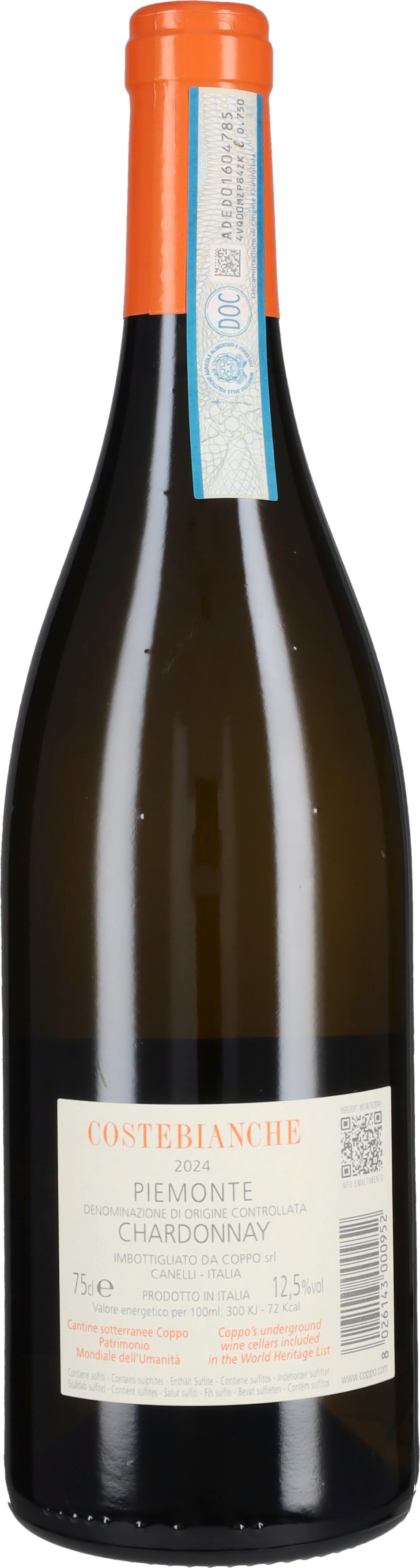
Chardonnay 'Costebianche' Coppo 2024The Chardonnay "Costebianche" is the youngest, freshest, and most immediate version of the whites produced by the Piedmontese winery Coppo with the famous Burgundy grape. The gentle hills of the Canelli area give rise to a label with a fresh face and great drinkability. The partial aging in wood does not alter the varietal profile of the wine, keeping the fruity notes in the foreground, enriched by light hints of tertiary evolution. Coppo's "Costebianche" is a pure Chardonnay that comes from vineyards cultivated on white-colored soils, characterized by clay-limestone marls, with the presence of silt. The over 50 hectares of vineyards are located at an altitude of about 200 meters above sea level, with sunny exposures oriented to the southeast, south, and southwest. The Chardonnay vines are trained in Guyot with a planting density of 4000 plants per hectare. At the end of the manual harvest, the grapes are softly pressed. 20% of the must is fermented and aged in barriques of second and third passage, while the rest is vinified in stainless steel tanks. Before being put on sale, the liquid ages for a few months in the cellar. “Costebianche” Chardonnay by Coppo is a label that confirms how well the famous French grape has adapted to the Piedmontese territory. It is a medium-bodied white that is appreciated for its varietal fidelity. It presents with a straw-yellow color with subtle greenish reflections. On the palate, it releases elegant floral aromas, citrus notes, white fruit, exotic hints, and herbal nuances. The taste is of beautiful fruity richness, with an expressive mid-palate and soft notes of tropical fruit. The finish is of good freshness and sapidity. A Piedmontese sip with an international stamp!16,00 £*Shipping: 48,00 £Secure redirect to the provider
-
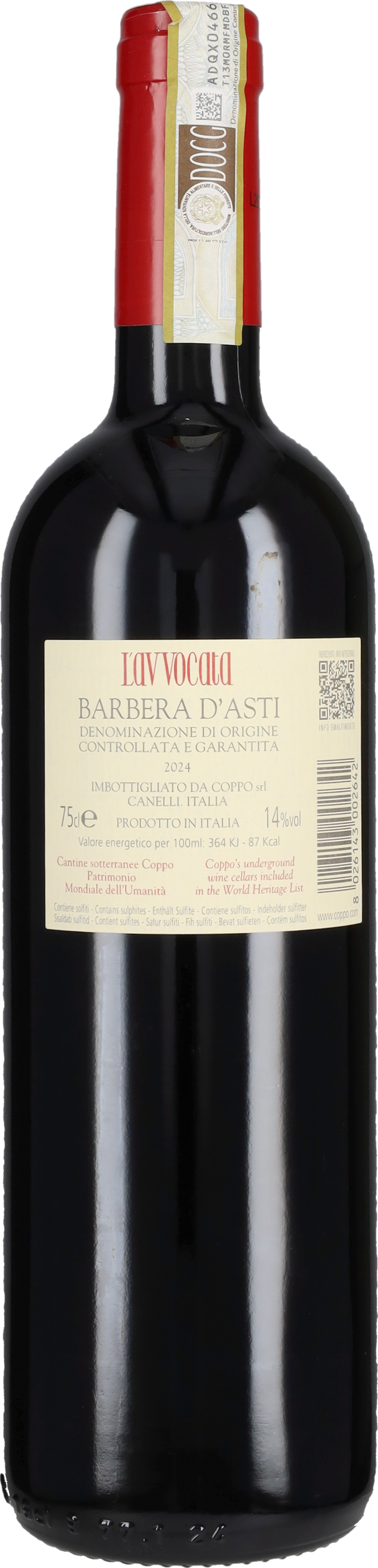
Barbera d'Asti 'L'Avvocata' Coppo 2025"L'Avvocata" by Coppo is a complex and juicy Barbera d'Asti, which has distinguished itself over the years not only for its high quality level but also for the extraordinary quality-price ratio. The name, curious and original, is a dedication from the Coppo family to the first owner of the vineyards: a woman lawyer. Her severe, authoritative, and rigid nature earned her the nickname later featured on the label, although it contrasts with the cheerful and carefree nature of the wine. The Barbera D'Asti "L'Avvocata" comes from vineyards located in the southern Asti area, around the Canelli area, home of Moscato D'Asti and Italian sparkling wine. When talking about the Coppo family, one refers to one of the oldest wineries in Italy, founded in 1892 and with about 125 years of uninterrupted wine production. The house style has always favored finesse over power, with wines that surprise for their fragrance and freshness without giving up complexity. The grapes that make it up come from vineyards located between 200 and 250meters above sea level located on clay-limestone marls. The selection of the bunches is done manually to select only the best ones, while after vinification it ages only in steel to preserve all its aromatic integrity. The red "L'Avvocata" by Coppo has a lively ruby red color adorned with violet reflections. From the first sniff, it impresses with the clarity of the fruit, ranging from cherry to raspberry. A sip that flows with suppleness, exemplary for its ability to combine freshness and tannin so harmoniously. It does not give up a long finish, while making extreme drinkability its best quality. A daily wine that is impossible to give up. One bottle may not be enough!13,00 £*Shipping: 48,00 £Secure redirect to the provider
-
"""Coppo Nizza Pomorosso 2022 Red Wine - Italy""""""We've never welcomed a Barbera to our Best In Show selection before – and pow! Here it is. Fittingly it's a Nizza wine, this Docg having come into being in 2014 to showcase a Barbera-only subzone formerly included in Docg Barbera d'Asti Superiore..."61,99 $*Shipping: 0,00 $Secure redirect to the provider


-
Do you say "Du backst" or "Du bäckst"?
The correct spelling is "Du backst." The verb "backen" is conjugated as "backst" in the second person singular form. The umlaut on the letter "a" is not used in this conjugation. **
-
Does it say "Du hältst" or "Du hältst"?
It says "Du hältst." **
-
Does it say "Du backst" or "Du bäckst"?
It says "Du backst." The verb "backen" (to bake) is conjugated as "backst" in the second person singular form in the present tense. The form "Du bäckst" would be incorrect in standard German. **
-
Why do we say "du hältst" but not "du setzt" instead "du setzt dich"?
In German, the verb "setzen" typically requires a direct object, so when using it in the second person singular form, it is often accompanied by a reflexive pronoun to indicate that the action is being performed on oneself. This is why we say "du setzt dich" instead of just "du setzt." On the other hand, the verb "halten" does not require a direct object, so it can be used on its own without a reflexive pronoun, resulting in "du hältst." This distinction in usage is a characteristic of the German language and its grammar rules. **
Was the Mauthausen concentration camp an extermination camp?
No, the Mauthausen concentration camp was not an extermination camp. While it was a brutal and deadly place where many prisoners died from forced labor, starvation, and mistreatment, it was not specifically designed for the mass murder of prisoners like extermination camps such as Auschwitz. However, many prisoners did perish at Mauthausen due to the harsh conditions and the cruelty of the camp's guards. **
What does "Du weißt nicht, was du willst?" mean?
"Du weißt nicht, was du willst?" is a German phrase that translates to "You don't know what you want?" in English. It is often used to express frustration or confusion towards someone who seems indecisive or unsure about their desires or intentions. The phrase can be used in various contexts, such as in relationships, decision-making, or when someone is being wishy-washy about their choices. **
Top-Angebote
Products related to Coppo-Camp-du-Rouss:
-
Barbera d'Asti 'Camp du Rouss' Coppo 2023The Piedmontese red wine “Camp du Rouss” is a Barbera d’Asti with a harmonious character, always fine and balanced, both on the nose and in the mouth, where it finishes with a distinctly fruity aftertaste. A label whose name means “the vineyard with red hair,” which aims to pay homage to the first owner of the plot, a man with reddish hair, of imposing stature, famous for instilling fear in the village children. Today, however, there is nothing to fear in uncorking this Barbera from Coppo, which indeed confirms its excellent levels year after year. This “Camp du Rouss” is a Barbera d’Asti that comes from the grapes of a variety widely cultivated within the regional borders, the Barbera. The vines of this variety grow with a southeast exposure and are trained using the Guyot system, within soils characterized by a clayey and calcareous subsoil, with a strong presence of silt. The grapes, once harvested during the harvest phase by the Coppo team, macerate in contact with the skins with brief and careful pump-overs, fermenting alcoholic. We then proceed with the aging phase, which takes place for 12 months in barrique of French oak, new for 20% and second passage for the remaining 80%. The Barbera d’Asti “Camp du Rouss” presents itself to the eye with a typically ruby color, very concentrated. The aromas that envelop the nose tell of sensations that are mainly fruity, enriched with notes of sweet spices. On the palate, it is full-bodied, with excellent balance, resulting from a sip in which the tannins are finely integrated; it finishes with a finale characterized by a particularly fruity aftertaste. A bottle with which the Coppo winery confirms its vocation in interpreting a traditional variety of Piedmontese viticulture, the Barbera.16,00 £*Shipping: 48,00 £Secure redirect to the provider
-
"""Coppo Camp du Rouss Barbera d'Asti 2023 Red Wine - Italy""""""This wine's ripe, dark-skinned fruit, culinary spice and new leather scents lead the way, along with a menthol note. The firmly structured, chewy palate offers dried Morello cherry, raspberry jam, licorice and espresso flavors alongside..."21,97 $*Shipping: 0,00 $Secure redirect to the provider
-
Nizza 'Pomorosso' Coppo 2023The Nizza “Pomorosso” by Coppo is born in Canelli, the capital of the Classic Method in Italy and home to high-quality reds. The history of the Coppo winery began in 1892, and from generation to generation, respect for the ecosystem, maximum care for the vineyards and each individual plant, and a courageous vision for the future have always been the fundamental goals to achieve and maintain. In addition to the national market, production also successfully targets the international market, reaching South America and the United States. Today, the fourth generation at work is represented by Luigi Coppo, who looks to the future of his family's business and the sustainability of every single production process. The pure Barbera grapes of the Nizza “Pomorosso” by Coppo grow on soil mainly composed of marl, clay, and limestone with small amounts of gypsum and iron for an elegant and characterful final product. The vineyards are located in the southern part of the Asti territory, a perfect position for the sun's rays to consistently hit the rows, ensuring perfect ripening of the grapes; the altitude, however, is about about 200 meters above sea level. The harvest takes place in wooden boxes of about 20 kg with a selection of the healthiest grapes; in the winery, there is a brief maceration in contact with the skins with delicate pump-overs, along with a malolactic fermentation. It ages for 14 months in barrique. The color of the Nizza “Pomorosso” by Coppo is an intense purple red with brilliant reflections. On the nose, there are notes of violet, blackberry, and cherry with a mineral finish reminiscent of graphite; on the palate, it is elegant, enveloping, and pleasantly tannic with a persistent finish that calls for glass after glass. It pairs perfectly with dishes based on grilled red meat, stews, and game; also perfect with aged cow's milk cheeses. Excellent for celebrating occasions and anniversaries with family, enjoying a traditional product that is an ideal ambassador of the authentic flavors of Piemonte.52,00 £*Shipping: 48,00 £Secure redirect to the provider
-
Chardonnay 'Costebianche' Coppo 2024The Chardonnay "Costebianche" is the youngest, freshest, and most immediate version of the whites produced by the Piedmontese winery Coppo with the famous Burgundy grape. The gentle hills of the Canelli area give rise to a label with a fresh face and great drinkability. The partial aging in wood does not alter the varietal profile of the wine, keeping the fruity notes in the foreground, enriched by light hints of tertiary evolution. Coppo's "Costebianche" is a pure Chardonnay that comes from vineyards cultivated on white-colored soils, characterized by clay-limestone marls, with the presence of silt. The over 50 hectares of vineyards are located at an altitude of about 200 meters above sea level, with sunny exposures oriented to the southeast, south, and southwest. The Chardonnay vines are trained in Guyot with a planting density of 4000 plants per hectare. At the end of the manual harvest, the grapes are softly pressed. 20% of the must is fermented and aged in barriques of second and third passage, while the rest is vinified in stainless steel tanks. Before being put on sale, the liquid ages for a few months in the cellar. “Costebianche” Chardonnay by Coppo is a label that confirms how well the famous French grape has adapted to the Piedmontese territory. It is a medium-bodied white that is appreciated for its varietal fidelity. It presents with a straw-yellow color with subtle greenish reflections. On the palate, it releases elegant floral aromas, citrus notes, white fruit, exotic hints, and herbal nuances. The taste is of beautiful fruity richness, with an expressive mid-palate and soft notes of tropical fruit. The finish is of good freshness and sapidity. A Piedmontese sip with an international stamp!16,00 £*Shipping: 48,00 £Secure redirect to the provider
-
What does 'du brunzkache du ogsoachte' mean?
The phrase "du brunzkache du ogsoachte" is in the Bavarian dialect of German and translates to "you're crazy, you're delusional" in English. It is used to express disbelief or to dismiss someone's ideas or actions as irrational or nonsensical. **
-
Is it said "Du backst" or "Du bäckst"?
The correct form is "Du backst." The verb "backen" means "to bake" in German, and when conjugated for the second person singular (du), it takes the form "backst." The umlaut (ä) in "bäckst" is incorrect in this context. **
-
Do you say "Du backst" or "Du bäckst"?
The correct spelling is "Du backst." The verb "backen" is conjugated as "backst" in the second person singular form. The umlaut on the letter "a" is not used in this conjugation. **
-
Does it say "Du hältst" or "Du hältst"?
It says "Du hältst." **
Similar search terms for Coppo-Camp-du-Rouss
-
Barbera d'Asti 'L'Avvocata' Coppo 2025"L'Avvocata" by Coppo is a complex and juicy Barbera d'Asti, which has distinguished itself over the years not only for its high quality level but also for the extraordinary quality-price ratio. The name, curious and original, is a dedication from the Coppo family to the first owner of the vineyards: a woman lawyer. Her severe, authoritative, and rigid nature earned her the nickname later featured on the label, although it contrasts with the cheerful and carefree nature of the wine. The Barbera D'Asti "L'Avvocata" comes from vineyards located in the southern Asti area, around the Canelli area, home of Moscato D'Asti and Italian sparkling wine. When talking about the Coppo family, one refers to one of the oldest wineries in Italy, founded in 1892 and with about 125 years of uninterrupted wine production. The house style has always favored finesse over power, with wines that surprise for their fragrance and freshness without giving up complexity. The grapes that make it up come from vineyards located between 200 and 250meters above sea level located on clay-limestone marls. The selection of the bunches is done manually to select only the best ones, while after vinification it ages only in steel to preserve all its aromatic integrity. The red "L'Avvocata" by Coppo has a lively ruby red color adorned with violet reflections. From the first sniff, it impresses with the clarity of the fruit, ranging from cherry to raspberry. A sip that flows with suppleness, exemplary for its ability to combine freshness and tannin so harmoniously. It does not give up a long finish, while making extreme drinkability its best quality. A daily wine that is impossible to give up. One bottle may not be enough!13,00 £*Shipping: 48,00 £Secure redirect to the provider
-
"""Coppo Nizza Pomorosso 2022 Red Wine - Italy""""""We've never welcomed a Barbera to our Best In Show selection before – and pow! Here it is. Fittingly it's a Nizza wine, this Docg having come into being in 2014 to showcase a Barbera-only subzone formerly included in Docg Barbera d'Asti Superiore..."61,99 $*Shipping: 0,00 $Secure redirect to the provider
-
"""Coppo Monteriolo Chardonnay 2023 White Wine - Italy""""""Bright yellow with golden hues, Monteriolo offers juicy flavors of ripe tropical fruits, such as pineapple and melon, followed by pure, fragrant aromas of vanilla, apple pie, caramel, and chamomile. On the palate, the bright acidity balances the..."68,99 $*Shipping: 0,00 $Secure redirect to the provider
-
"""Coppo Langhe Nebbiolo 2023 Red Wine - Italy""""""The wine opens with a bouquet of small red fruits, including strawberry and raspberry, complemented by subtle hints of withered violet. On the palate, it is fresh and mineral at the front, with well-integrated, delicate tannins and a lingering,..."24,99 $*Shipping: 0,00 $Secure redirect to the provider
-
Does it say "Du backst" or "Du bäckst"?
It says "Du backst." The verb "backen" (to bake) is conjugated as "backst" in the second person singular form in the present tense. The form "Du bäckst" would be incorrect in standard German. **
-
Why do we say "du hältst" but not "du setzt" instead "du setzt dich"?
In German, the verb "setzen" typically requires a direct object, so when using it in the second person singular form, it is often accompanied by a reflexive pronoun to indicate that the action is being performed on oneself. This is why we say "du setzt dich" instead of just "du setzt." On the other hand, the verb "halten" does not require a direct object, so it can be used on its own without a reflexive pronoun, resulting in "du hältst." This distinction in usage is a characteristic of the German language and its grammar rules. **
-
Was the Mauthausen concentration camp an extermination camp?
No, the Mauthausen concentration camp was not an extermination camp. While it was a brutal and deadly place where many prisoners died from forced labor, starvation, and mistreatment, it was not specifically designed for the mass murder of prisoners like extermination camps such as Auschwitz. However, many prisoners did perish at Mauthausen due to the harsh conditions and the cruelty of the camp's guards. **
-
What does "Du weißt nicht, was du willst?" mean?
"Du weißt nicht, was du willst?" is a German phrase that translates to "You don't know what you want?" in English. It is often used to express frustration or confusion towards someone who seems indecisive or unsure about their desires or intentions. The phrase can be used in various contexts, such as in relationships, decision-making, or when someone is being wishy-washy about their choices. **
* All prices are inclusive of VAT and, if applicable, plus shipping costs. The offer information is based on the details provided by the respective shop and is updated through automated processes. Real-time updates do not occur, so deviations can occur in individual cases. ** Note: Parts of this content were created by AI.